Windows Server 2025 vs 2022: Standard or Datacenter?
Karınca Lisans10 min read
Products Mentioned in This Post
Summarize this article with AI
Your assistant reads the article and summarizes it for you.
Short answer: Windows Server 2025 is the current release that succeeds Windows Server 2022 and carries a support horizon that runs five years longer; the Standard edition licenses one physical server with rights for 2 virtual machines, while Datacenter adds unlimited virtual machines, Storage Spaces Direct, and software-defined networking through Network Controller. A small or mid-sized office that never needs more than two VMs is well served by Standard; organizations that virtualize heavily, build hyper-converged storage, or host many VMs should look at Datacenter.
This guide summarizes what Windows Server 2025 changes compared with 2022 based on Microsoft's official "What's new" documentation, lays out the Standard versus Datacenter differences in a table drawn from the official edition comparison, and covers licensing basics and lifecycle dates. It is written for anyone asking "which edition should I buy?", from a small business owner setting up a first server to an administrator running a Hyper-V cluster.
Key Takeaways
- Windows Server 2025 shipped on November 1, 2024 and follows Microsoft's Fixed Lifecycle Policy, with mainstream support through November 2029 and extended support through November 2034.
- Mainstream support for Windows Server 2022 ends in October 2026; extended support continues until October 2031.
- The decisive difference between Standard and Datacenter is virtualization rights: Standard covers 2 virtual machines, Datacenter covers an unlimited number.
- Storage Spaces Direct, Network Controller, and Host Guardian Hyper-V support are Datacenter-only; core roles such as Active Directory, DNS, DHCP, file, and web server are identical in both editions.
- Headline 2025 features include Hotpatch via Azure Arc, SMB over QUIC in every edition, Credential Guard enabled by default, a 32k Active Directory database page size, and in-place upgrades directly from Windows Server 2012 R2.
What Is New in Windows Server 2025
Windows Server 2025 is the latest Long-Term Servicing Channel (LTSC) release and brings concrete changes to the security, virtualization, and storage layers compared with 2022. The following highlights come from Microsoft's What's new in Windows Server 2025 page:
- Hotpatch: Windows Server 2025 machines connected to Azure Arc can install OS security updates without a restart. According to Microsoft's Hotpatch documentation, Azure Arc-enabled Hotpatch is available for both the Standard and Datacenter editions of 2025; in Windows Server 2022 it was limited to Datacenter: Azure Edition.
- SMB over QUIC in all editions: Encrypted file access over the internet without a VPN, previously exclusive to Azure Edition, is now available in Standard and Datacenter.
- Hardened defaults: Credential Guard is enabled by default on hardware that meets the requirements, SMB signing is now required for all outbound connections, and administrators get an SMB authentication rate limiter plus the option to disable SMB NTLM.
- Active Directory 32k database pages: The 8k page size used since Windows 2000 can optionally move to 32k, allowing multivalued attributes to hold roughly 3,200 values. A new delegated Managed Service Account (dMSA) type simplifies migrating away from traditional service accounts.
- Hyper-V scale and GPU partitioning: Up to 4 PB of memory and 2,048 logical processors per host, and up to 240 TB of memory with 2,048 virtual processors for generation 2 VMs. GPU partitioning (GPU-P) lets several VMs share one physical GPU, and generation 2 is now the default for new VMs.
- Storage: Optimized NVMe performance, Storage Replica compression, ReFS native deduplication and compression, and thin provisioned volumes on Storage Spaces Direct.
- Upgrades and management: In-place upgrade from Windows Server 2012 R2 and later (up to four versions in one jump), WinGet installed by default, Windows Terminal, and built-in ZIP, 7z, and TAR compression.
Windows Server 2022, by contrast, introduced foundations such as secured-core server, TLS 1.3 by default, and hybrid management through Azure Arc; 2025 builds on that base rather than replacing it. As of September 2026, if you are deploying a new server, 2025 is the sensible default because it offers a much longer support window for the same license type. Windows Server 2022 remains a valid choice when you need to match an existing environment exactly or when your line-of-business vendor has not yet certified 2025.
Standard vs. Datacenter: The Real Differences
Windows Server Standard and Datacenter share the same operating system core; the difference lies in virtualization rights and a handful of infrastructure features reserved for Datacenter. The table below combines Microsoft's official edition comparison (Windows Server 2025 view) with the virtual machine rights stated on Karınca's product pages:
| Feature | Standard | Datacenter |
|---|---|---|
| Virtual machine (OSE) rights | 2 virtual machines | Unlimited |
| Core roles (AD DS, DNS, DHCP, file, IIS, Hyper-V) | Included | Included |
| Storage Spaces Direct (S2D) | No | Yes |
| Network Controller (software-defined networking) | No | Yes |
| Host Guardian Hyper-V support (shielded VMs) | No | Yes |
| GPU partitioning | Standalone hosts only | Including clusters |
| Automatic VM activation (AVMA) | Only as a guest on a Datacenter host | Yes |
| Hotpatch (via Azure Arc) | Yes | Yes |
| SMB over QUIC | Yes | Yes |
| Storage Replica | Yes | Yes |
The first row is the one that matters most. With a Standard license you can install the Hyper-V host on one physical server and run 2 virtual machines on it; the moment you need a third VM, you either add a second Standard license or move to Datacenter. Storage Spaces Direct, exclusive to Datacenter, is the hyper-converged technology that pools local disks from several servers into one resilient storage layer, and Network Controller is the SDN component that manages network policy centrally. If you will not use either of those, the only real benefit of Datacenter is the unlimited VM right.
Licensing Basics: What You Are Actually Buying
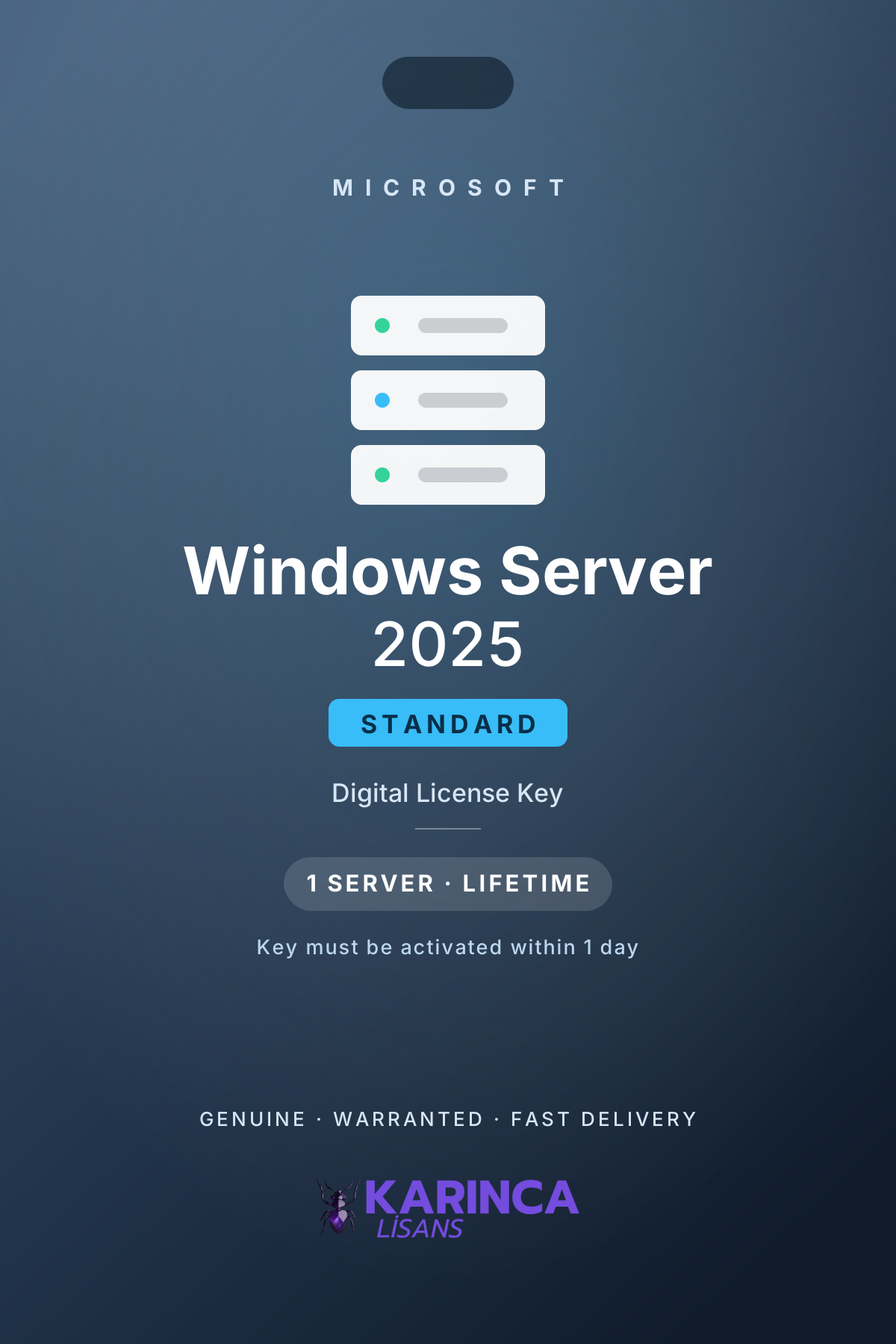
A Windows Server license is the right to run the operating system on one physical server; it does not include client access licenses (CALs) for the users or devices that connect to it. The product page for the Windows Server 2025 Standard license at Karınca states this plainly: the key is for a single physical server, remains valid on that server for life, grants rights for 2 virtual machines (OSEs), and user CALs and RDS licenses are purchased separately. The same structure applies to the Windows Server 2025 Datacenter license, with unlimited VMs as the only difference.
On the corporate volume-licensing side, Microsoft licenses Windows Server by the number of processor cores in the server and additionally requires a CAL per user or per device. Core counting, minimum pack rules, and CAL types vary by agreement, so verify those details in Microsoft's licensing documentation or with an authorized licensing advisor; we deliberately avoid quoting numbers from memory here. Keep in mind that every user who connects through Remote Desktop needs an RDS CAL as a separate line item. Our article on OEM vs. Retail license differences explains how digital keys are sourced and what the channel means for reinstallation; the same logic applies to server keys.
Two practical rules apply to server keys sold at Karınca: the key must be activated within 1 day of delivery, and once the activated installation is formatted, the same key cannot be reused. We therefore recommend ordering when the server's permanent installation is ready to activate.
Support Lifecycle Dates
Every Windows Server release follows Microsoft's Fixed Lifecycle Policy: five years of mainstream support followed by five years of extended support. The dates below are taken from Microsoft's lifecycle pages; because those pages express the end dates as Pacific-time timestamps, the table shows them at month level, and you should rely on the official Windows Server 2025 and Windows Server 2022 lifecycle pages for day-level planning.
| Version | Released | Mainstream support ends | Extended support ends |
|---|---|---|---|
| Windows Server 2025 | November 2024 | November 2029 | November 2034 |
| Windows Server 2022 | August 2021 | October 2026 | October 2031 |
| Windows Server 2019 | November 2018 | January 2024 (ended) | January 2029 |
| Windows Server 2016 | October 2016 | January 2022 (ended) | January 2027 |
Mainstream support is the phase in which new features and design changes arrive; extended support delivers security updates only. Mainstream support for Windows Server 2022 ends in October 2026, right after this article is published; the license stays valid indefinitely and security patches continue until 2031, but you should not expect new capabilities. Extended support for 2025 reaching into 2034 creates an eight-year gap that, for an organization planning to run the same hardware for a long time, can decide the question on its own.
Which Edition Fits Which Organization?
The right question is not "which edition is more powerful?" but "how many virtual machines will I run, and will I use S2D or SDN?" A typical small-office setup hosting a file server, a domain controller, and an accounting application runs comfortably as 2 virtual machines on Hyper-V, and Standard covers that scenario completely. A ten-VM test environment, a hosting provider, or a three-node hyper-converged cluster needs Datacenter, both for the VM count and for Storage Spaces Direct.
Our support team at Karınca Lisans helps server customers choose an edition and get through activation, and the situation we see most often is a business that starts with 2 VMs and needs a third one six months later. At that point the decision between a second Standard key and a move to Datacenter depends on the planned VM count: up to four VMs, two Standard licenses usually stay cheaper; at five or more, Datacenter is worth pricing out. The second common misunderstanding we observe is the assumption that RDS CALs for Remote Desktop users are included in the server license; they are not, and we say so before the order is placed.
Do Windows Server 2019 or 2016 Still Make Sense?
Windows Server 2019 receives security updates until January 2029, which keeps it defensible in specific scenarios: if the application you run is certified only on 2019, or if you are adding a node to an existing cluster that must stay on the same version, 2019 is the correct choice. Extended support for Windows Server 2016 ends in January 2027; the only reason to choose 2016 for a new deployment is legacy hardware or an application that demands it, and even then you should plan the migration now.
When the price gap is small and your software allows it, going straight to 2025 rather than 2022 for a new deployment is the path with the least friction. Existing 2022 installations do not need an urgent migration when mainstream support ends in October 2026, because security patches continue until 2031. Karınca's Windows Server Standard licenses and Windows Server Datacenter licenses categories list every version from 2016 to 2025 as a separate product, and the Windows Server 2022 Standard license is sold under the same single-physical-server rule with the same 2 virtual machine rights.
Which Option Should You Choose?
- One physical server, at most 2 virtual machines, core roles: Windows Server 2025 Standard. Support runs until 2034 and the price-to-capability balance is the best of the lineup.
- 3 to 4 virtual machines, no S2D or SDN: Two Standard licenses are usually cheaper than Datacenter; count your total VMs before deciding.
- 5 or more virtual machines, hyper-converged cluster, hosting: Windows Server 2025 Datacenter. Unlimited VMs, Storage Spaces Direct, and Network Controller are what this scenario requires.
- Adding a node to an existing 2022 environment, or a vendor that has not certified 2025: Windows Server 2022 Standard; extended support lasts until 2031.
- An application certified only on 2019: Windows Server 2019; it receives security patches until 2029, but prepare the migration plan now.
Once you have decided, read the activation steps on the product page before ordering: the key is delivered by email with an invoice and should be activated on the server's permanent installation. If you are unsure about the edition, send your VM count and planned roles to our WhatsApp support line and we will point you to the right product.
Frequently Asked Questions
How many virtual machines can I run with Windows Server 2025 Standard?
The Standard license grants rights for 2 virtual machines (OSEs) on one physical server; the Hyper-V host itself is covered as long as it is used only to manage those VMs. For more virtual machines you need either a second Standard license or Datacenter, which allows an unlimited number.
Do I have to move from Windows Server 2022 to 2025?
No. Extended support for Windows Server 2022 continues until October 2031, and it receives security updates until then. Because mainstream support ends in October 2026, no new features will arrive; choosing 2025 makes more sense for new deployments and long-lived hardware rather than as an urgent upgrade.
Are user CALs included in a Windows Server license?
They are not. The Windows Server license covers running the operating system on the server; every user or device that connects needs a separate CAL, and Remote Desktop sessions additionally require an RDS CAL. These items are not included with the server keys sold at Karınca, and the product page states this.
Do I need Datacenter to use Hotpatch?
Not on Windows Server 2025. According to Microsoft's Hotpatch documentation, Windows Server 2025 Standard and Datacenter machines connected to Azure Arc can receive security updates that do not require a restart. On Windows Server 2022 the feature was limited to Datacenter: Azure Edition.